

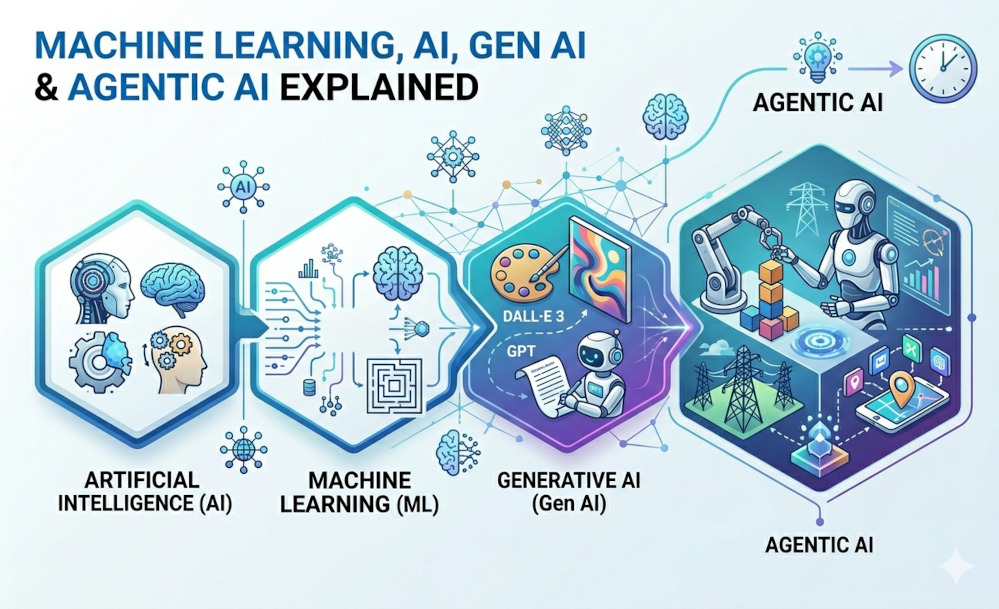
Artificial Intelligence (AI) has become a ubiquitous term, yet its various facets can often be confusing. This post aims to demystify the landscape of AI, breaking down Machine Learning, Generative AI, and the emerging concept of Agentic AI.
What is Artificial Intelligence (AI)?
At its core, Artificial Intelligence refers to the simulation of human intelligence in machines that are programmed to think like humans and mimic their actions. It's an umbrella term encompassing a wide range of technologies and techniques that enable machines to perform tasks that typically require human intelligence, such as learning, problem-solving, decision-making, perception, and language understanding.
Machine Learning (ML): The Foundation of Modern AI
Machine Learning is a subset of AI that focuses on enabling systems to learn from data without being explicitly programmed. Instead of following rigid instructions, ML algorithms identify patterns and make predictions or decisions based on the data they've been trained on. This learning process allows ML models to improve their performance over time as they are exposed to more data.
Key Concepts in Machine Learning:
- Supervised Learning: Training models on labeled datasets, where the desired output is known (e.g., predicting house prices based on features).
- Unsupervised Learning: Finding hidden patterns or structures in unlabeled data (e.g., clustering customer segments).
- Reinforcement Learning: Training agents to make a sequence of decisions in an environment to maximize a reward (e.g., teaching a robot to navigate a maze).
Generative AI (Gen AI): Creating New Content
Generative AI is a powerful and rapidly evolving branch of AI that focuses on creating new, original content that resembles human-generated work. Unlike traditional AI that analyzes existing data, Generative AI models learn the patterns and structures within a dataset and then use that understanding to produce novel outputs.
How Generative AI Works:
Generative AI models, such as Generative Adversarial Networks (GANs) and Transformer models, are trained on vast amounts of data (text, images, audio, etc.). Through this training, they learn the underlying distributions and relationships in the data. Once trained, they can generate new samples that are statistically similar to the training data but are not direct copies.
Applications of Generative AI:
- Generating realistic images and art (e.g., DALL-E, Midjourney).
- Creating human-like text and stories (e.g., GPT-3, GPT-4).
- Composing music.
- Developing synthetic data for training other AI models.
- Designing new drugs and materials.
Agentic AI: AI with Autonomy and Purpose
Agentic AI represents a more advanced paradigm where AI systems are designed as autonomous agents capable of perceiving their environment, making decisions, taking actions, and working towards specific goals without constant human intervention. These agents are not just responding to prompts; they are proactively planning and executing tasks.
Characteristics of Agentic AI:
- Autonomy: Ability to operate independently for extended periods.
- Goal-Oriented: Designed to achieve specific objectives.
- Proactive Behavior: Initiating actions rather than just reacting.
- Environmental Perception: Sensing and interpreting information from their surroundings.
- Learning and Adaptation: Improving their strategies and performance over time.
Examples and Potential of Agentic AI:
Imagine an AI agent tasked with planning a complex travel itinerary. Instead of you prompting it at each step (find flights, book hotel, plan activities), an agentic AI would independently research, compare options, make bookings, and even adapt the plan if unforeseen circumstances arise, all while keeping your preferences in mind.
Agentic AI is still in its nascent stages, but it holds immense promise for automating complex workflows, creating more intelligent personal assistants, and driving innovation in fields ranging from scientific research to robotic control.
The Relationship Between Them
It's important to understand that these concepts are not mutually exclusive but rather build upon each other:
- AI is the broad field of intelligent machines.
- Machine Learning is a technique that enables AI systems to learn from data.
- Generative AI uses ML techniques to create new content.
- Agentic AI leverages ML and potentially Generative AI to create autonomous, goal-oriented systems that can act independently.
Conclusion
The journey from basic AI concepts to the sophisticated capabilities of Agentic AI showcases the rapid evolution of artificial intelligence. As these technologies continue to advance, they will undoubtedly reshape industries, enhance human capabilities, and create new possibilities we can only begin to imagine.